How Cloud-Native Hype Replaced Architecture with Infinite Loops — and Why AI Is Pouring Concrete Over the Grave
An edge team needed two static, account-level telemetry features per cloud account: one cross-account observability link, and a three-object WAF logging pipeline (a log group, a CloudWatch Logs resource policy, and a subscription filter). None of these four AWS objects scales with traffic. None of them changes per tenant. Zero packets of customer traffic and zero log records ever pass through Kubernetes. Yet both features ended up as 24x7 infinite for loops inside leader-elected Kubernetes Deployment pods — where correctness suddenly depends on replicaCount, omitted Go interfaces, unfenced etcd leases, and tag-based state recovery.
This is not a story about one team’s code; every line was clean, reviewed, and locally rational. It is a forensic diagnosis of a ten-year industry tragedy: how fifty years of software engineering discipline — information hiding, static types, state machines, and build-time DAGs — got buried alive when a cluster Ops tool was crowned the universal Software Development Engineering (SDE) platform. And it is a warning about why AI coding agents are now pouring concrete over the grave.
1. The Premise Anomaly: A 100% Cloud-Native System with a Container Scheduler in Front of It
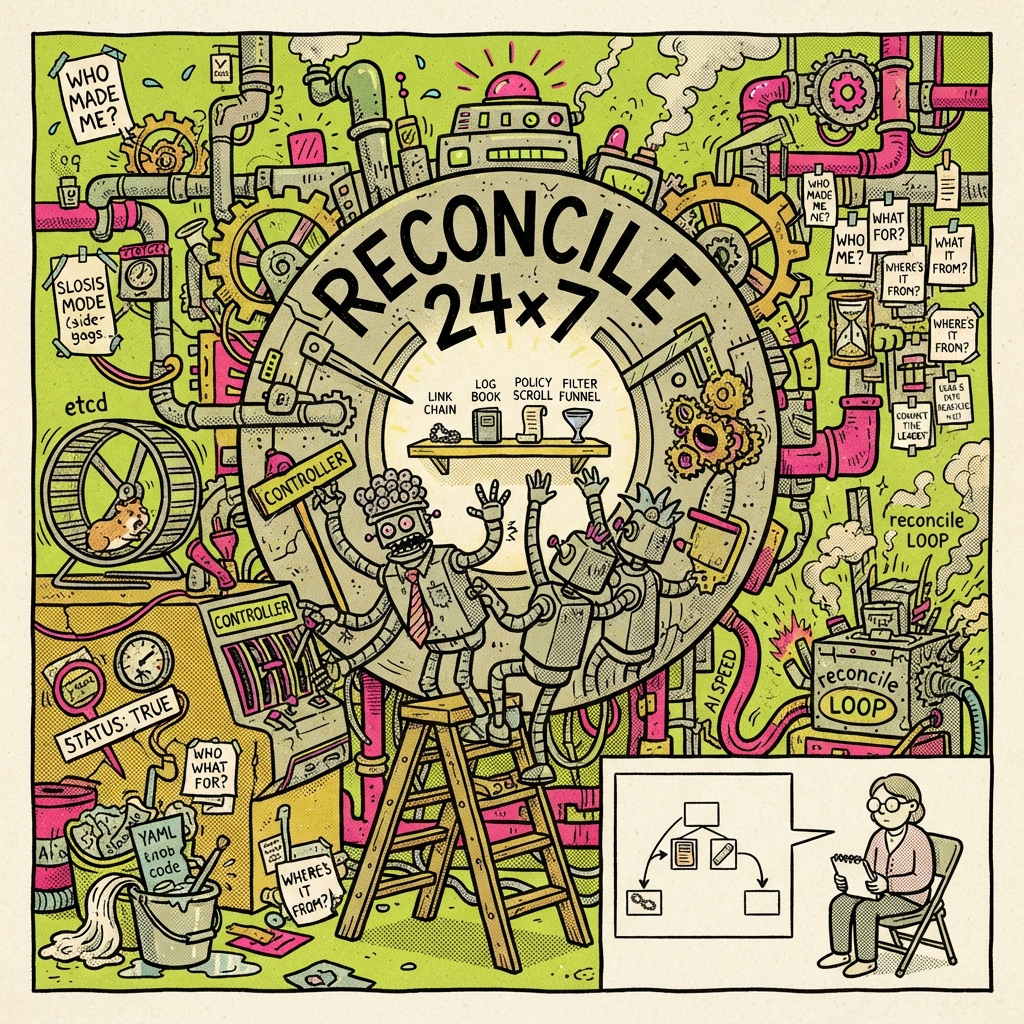
Look at a modern multi-tenant SaaS edge stack built on AWS:
- Traffic plane: Route53 → CloudFront (Multi-Tenant Distributions
[MTD]+ Distribution Tenants) + WAFv2 + ACM certificates. - Telemetry plane: CloudFront & WAFv2 → CloudWatch Metrics & Logs → (a) CloudWatch Observability Access Manager (OAM) cross-account link → central monitoring / Grafana, and (b) Subscription Filter → Kinesis Data Firehose → SIEM.
Every single component in both planes is an AWS managed service. Not one HTTP request and not one log line passes through a Kubernetes pod at the edge tier. AWS is the runtime.
If a software engineer designed this control plane from first principles, Kubernetes would not appear in the diagram. You have AWS accounts, AWS APIs, and a finite provisioning program (AWS CDK / CloudFormation StackSets, or Terraform) that compiles a dependency graph, previews a diff, serializes writes, and exits — with server-side compensating rollback where CloudFormation backs the stack.
Instead, across thousands of engineering organizations that adopted “everything is a Kubernetes operator + GitOps” as their unified platform standard over the past decade, an Amazon EKS cluster sits in front of those AWS APIs solely as a control-plane middleman:
flowchart TB
  subgraph AWS["Actual Edge & Telemetry Runtime (100% AWS Managed — 0% in K8s)"]
    R53["Route53"] --> CF["CloudFront (MTD) + WAFv2 + ACM"]
    CF --> CWM["CloudWatch Metrics & Logs"]
    CWM --> OAM["OAM Cross-Account Link -> Grafana"]
    CWM --> Sub["Subscription Filter -> Firehose -> SIEM"]
  end

  subgraph K8S["Control-Plane Middleman (EKS Cluster Calling AWS HTTPS APIs)"]
    Helm["Helm / Flux GitOps"] --> Etcd["etcd CRDs & Env Vars"]
    Etcd --> PodA["Operator Pod A (Leader)\nfor { reconcileAWS(); sleep(1h) }"]
    Etcd --> PodB["Operator Pod B (Standby)\n0 reconciles · polls Lease every 2s · holds RAM"]
  end

  PodA -->|"STS AssumeRole + AWS SDK"| CF
  PodA -->|"STS AssumeRole + AWS SDK"| CWM
Now watch what happens when that static, account-level requirement arrives: “Share each CDN account’s CloudFront telemetry via one AWS::Oam::Link, and provision one WAF log group + CloudWatch Logs resource policy + subscription filter per account.”
In CloudFormation StackSets or AWS CDK, that is ~30 lines of declarative constructs applied once when an account is onboarded.
Inside a Kubernetes operator, an AWS account is not even a Custom Resource. Because the link exists once per cloud account rather than once per distribution CR, there is no Kubernetes object to watch — and a one-shot Kubernetes Job still lacks a state inventory, pre-apply diff, or teardown lifecycle. Since the long-running operator pod already holds warm cross-account AWS credentials, teams take the path of least resistance: they bolt a standalone background loop directly onto the operator startup.
At that moment, even the CRD reconciliation façade drops away. What remains is a raw for { reconcile(); time.Sleep(time.Hour) } goroutine hosted inside a Deployment container — waking up 8,760 times a year per account to check whether a static CloudWatch link nobody touched is still there.
2. The Abstraction Leak: When replicaCount Becomes a Correctness Variable
The foundational promise of cloud-native compute is orthogonality between application logic and instance count. In a stateless HTTP service, replicaCount belongs to Ops: scaling from 1 to 2 replicas or draining a node improves availability without changing what the program means.
The moment a Deployment is used to mutate external cloud APIs, physical pod topology leaks straight up into program correctness. In a single-shot CLI provisioner, “what happens when N starting replicas run this function concurrently?” cannot happen by construction. Inside an operator (replicaCount: 2, LeaderElection: true), main.go offers no compile-time phase guardrails, routinely producing four distinct replica execution regimes inside one binary:
Execution regime in main() |
Which pods run it | Why | What leaks into correctness |
|---|---|---|---|
1. Pre-mgr.Start bootstrap |
Every pod on container boot | Direct client calls compile identically before and after mgr.Start(), outside leader election |
Every booting pod races CreateOrUpdate on cluster-scoped CRs against the active leader; an unretried 409 Conflict crashes startup (os.Exit(1)) |
| 2. Registered controllers | Leader pod only | Attached to controller-runtime’s leader-election group |
Standby pod performs 0 reconciles while polling the Lease every 2s, syncing any pre-indexed or non-leader informer caches, and holding reserved CPU/RAM |
3. Bare manager.Runnable loops |
Leader pod only (implicitly) | Implements Start(ctx) and omits LeaderElectionRunnable |
Single-pod execution in steady state — governed by a silent runtime type-switch fallback (below) |
4. NeedLeaderElection() = false |
Every pod concurrently | Explicit opt-out for in-process RPC subscribers and placement caches | Each replica maintains uncoordinated in-memory resource counts between periodic refreshes, so two pods can select the same “least-loaded” target account simultaneously |
Look closely at Regime 3 vs. Regime 4 in upstream sigs.k8s.io/controller-runtime (pkg/manager/runnable_group.go). mgr.Add(r) accepts any Runnable implementing Start(context.Context) error. Whether r runs on one leader pod or on every replica is decided at runtime by an optional interface check:
switch runnable := fn.(type) {
// ... *Server, hasCache, webhook.Server ...
case warmupRunnable, LeaderElectionRunnable:
    // ... optional warmupRunnable hook ...
    leaderElectionRunnable, ok := fn.(LeaderElectionRunnable)
    if !ok {
        return r.LeaderElection.Add(fn, nil)
    }
    if !leaderElectionRunnable.NeedLeaderElection() {
        return r.Others.Add(fn, nil)
    }
    return r.LeaderElection.Add(fn, nil)
default:
    return r.LeaderElection.Add(fn, nil)
}
A bare Runnable implements neither warmupRunnable nor LeaderElectionRunnable, so it misses every case and lands silently in default: return r.LeaderElection.Add(fn, nil). Nothing at the call site mgr.Add(accountLoop) tells the reader whether it runs once per cluster or N times across N pods. Copy-pasting NeedLeaderElection() bool { return false } from a neighbouring runnable in the same file moves an AWS writer onto every replica with zero compiler warnings.
3. A Kubernetes Lease Cannot Fence AWS
Suppose every developer remembers the interface rule and puts every AWS loop inside the leader-elected group. Does that guarantee single-writer access to AWS?
No. Upstream k8s.io/client-go/tools/leaderelection states the limit plainly in its package header:
“This implementation does not guarantee that only one client is acting as a leader (a.k.a. fencing).”
A true fencing lock issues a monotonically increasing token with every lock acquisition, and the target storage server rejects any write carrying an older token. Neither kube-apiserver nor AWS inspects a Lease’s leaseTransitions counter. Inside etcd, controllers at least share one uniform per-object metadata.resourceVersion compare-and-swap primitive. Across external HTTPS APIs (oam:CreateLink, logs:PutResourcePolicy, wafv2:UpdateWebACL, cloudfront:UpdateDistribution), even that uniform CAS disappears:
Pod A (old leader: GC/VM freeze or in-flight HTTPS call outliving 15s LeaseDuration)
  └─ delayed PutResourcePolicy / CreateLink ────────────► AWS API (no Lease check)
                                                            ▲
Pod B (acquires Lease in etcd after 15s)                    │ concurrent write!
  └─ starts runnable ──► PutResourcePolicy / CreateLink ────┘
Because leader election only reduces contention without fencing external APIs, careful leader-only code still has to write multi-writer concurrency guards against its own twin pod:
- Handling
ConflictExceptionraces onCreateLinkin case a sibling pod or prior run created the link moments earlier. - Threading service-specific optimistic-lock tokens where AWS offers them (
ETagon CloudFront,LockTokenon WAFv2,ExpectedRevisionIdon resource-scoped CloudWatch Logs resource policies — while account-scoped CloudWatch Logs resource policies expose no revision token at all).
4. When the Middleman Writes Code to Defend Against Itself
A build-time infrastructure engine gives you four primitives before touching a cloud account: a pre-execution diff (plan / change set), serialized mutation (state lock or stack lock), an authoritative resource inventory, and a dependency DAG (DependsOn).
Routing cloud provisioning through a Kubernetes operator strips away all four while inserting etcd (plus Crossplane/Upbound or AWS Controllers for Kubernetes [ACK] Managed Resource CRDs) in between. Look at the compensating Go code that reappears inside the operator:
- Rebuilding state inventories out of AWS tags. Without a state file, a bare runnable cannot tell which OAM link it created versus one created by another stack, so it stamps custom ownership tags and hand-codes tag-filtering delete guards when configuration changes.
- Hand-sorting a flat slice instead of declaring a DAG. Many operator frameworks execute sub-resources as a flat
[]Resourceslice (applyOpsthenobserveOps), exiting early on the first error or in-progress step. RegisteringPutLoggingConfigurationbefore attaching theWebACLARN to the CloudFront distribution in that slice means a CloudWatch logging hiccup blocks WAF traffic protection. Topological sorting and failure isolation must be encoded manually by slice index. - Splitting one reconcile across two paradigms because of wrapper lag. Where Crossplane or ACK wraps an older AWS resource (a CloudWatch log group), the operator writes a CRD reconciled a second time by provider pods. Where AWS ships a newer capability the provider has not wrapped yet (CloudFront Multi-Tenant Distributions), the exact same reconcile drops down to imperative AWS SDK v2 calls — plus 1-minute polling timers because raw AWS APIs emit no Kubernetes watch events. Architectural boundaries inside the codebase end up drawn by wrapper release lag, not domain design.
- Writing recovery code to survive
etcdcorruption. Mature cloud-managing operators explicitly document that controllers cannot trust their own.statusas the source of truth acrossetcdbackup restores or manual status edits, implementing 3-step fallback scans against AWS (lookup by.statusID → scan byCallerReference→ scan byNametag) to rediscover resources that already exist intact in AWS.
Read that last bullet plainly. AWS already holds the unbroken source of truth. A substantial fraction of the operator’s codebase exists solely to survive state loss in the etcd .status layer that Kubernetes itself introduced.
5. The Deeper Disease: Forcing an Ops Tool to Do SDE Buried Fifty Years of Discipline
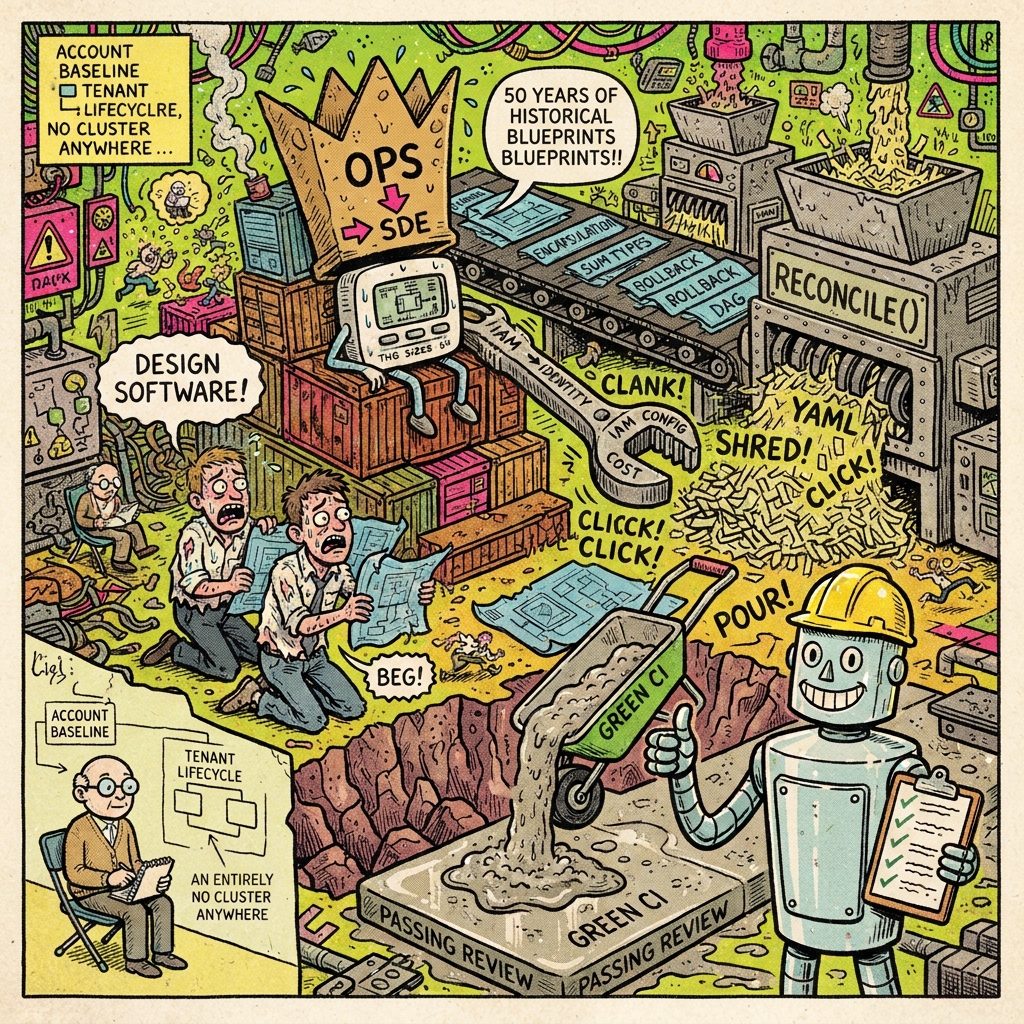
Why do all of these pathologies keep showing up across completely different companies, teams, and cloud providers?
Because around 2017, the cloud-native movement made a foundational category error: it took an Ops runtime tool and crowned it the universal Software Development Engineering (SDE) platform.
Ops vs. SDE: Two Opposite Problem Shapes
Kubernetes (v1.0, 2015) was built by cluster operations engineers, modeled after Borg, to solve an Ops problem: continuously converge processes and endpoints that the cluster itself hosts. When nodes fail, pods crash, or Envoy endpoints churn every minute, an infinite level-triggered loop nudging local reality back is genuinely the right model.
Software Development Engineering (SDE) — domain modeling, cloud provisioning, multi-resource lifecycle orchestration — has the opposite shape. Its core problem is maintaining invariants across multiple distinct external objects through deterministic, ordered state transitions: issue the certificate, validate DNS, attach the distribution, flip the route — commit the graph in dependency order or run explicit compensating rollback; tear down in reverse order; catch broken cross-object references at compile time before shipping.
Even modern Kubernetes additions — structural OpenAPI v3 schemas, CEL transition rules (x-kubernetes-validations), and Server-Side Apply (SSA) — only validate one YAML document at a time at API admission (runtime). Pressing etcd CRDs + Operators into being a general-purpose software architecture substrate wiped out seven foundational abstractions that computer science spent fifty years building:
| SDE Abstraction (50 years of CS) | Form in Typed Code & DDD | What Kubernetes Gives You Instead | What Breaks in Production |
|---|---|---|---|
| 1. Encapsulation | private state, module boundaries, Aggregate Roots |
Global mutable blackboard (etcd): RBAC gates whole resources, not private invariants; SSA Force: true overwrites sibling managers |
Silent cross-controller field erasure, field-manager collisions, and controllers watching their own .status against clobbering |
| 2. Compile-time composition & DAGs | Constructor injection, typed references, module graphs checked before execution | Watch + ResourceNotReady requeue: cross-object edges are discovered at runtime by crashing and retrying |
Dependency cycles, missing upstream writers, and slice-order bugs ship green and detonate in live clusters |
| 3. Multi-object consistency & rollback | Aggregate boundaries, compensating stack rollback | Single-object resourceVersion CAS only; zero cross-object rollback (ownerReference is async GC, not a transaction) |
Half-applied provisions and wedged Terminating resources sitting stuck while every controller reports local health |
| 4. Exhaustive sum types | Algebraic types (Pending \| Active \| Failed), compiler-checked matching |
Bag of single-CRD status.conditions strings + booleans |
"Ready=False" conflates “still converging”, “permanently broken”, and “waiting on an upstream step that never fired” |
| 5. Enforced interface contracts | Compiler-checked interfaces and method signatures | Unenforced runtime conventions (ObservedGeneration should be set; LeaderElectionRunnable may be implemented) |
Omitting one method silently flips pod execution scope; upstream providers omitting ObservedGeneration on error paths bypass guards |
| 6. Call-stack error propagation | Typed errors returned directly to the caller | Write a string into your own .status and hope another controller polls it |
Six controllers all report "reconcile succeeded" while the customer’s environment returns 404 |
| 7. Deterministic lifecycle (RAII) | Ordered constructors and reverse-order destructors | Uncoordinated finalizer vetoes with zero protocol among participants |
Teardown deadlocks whenever Controller A waits on a resource Controller B refuses to release first |
The Interrupted Synthesis of 2017–2018: Four Orthogonal Primitives Flattened into One Loop
Before 2016, software engineering already had a mature playbook — Domain-Driven Design, static type systems, explicit statecharts — whose tactical guarantees were largely confined to a single process. Standalone UML CASE tools had already taught SDEs a hard lesson: diagrams divorced from compilable code rot on day two; the graph has to live in code that a compiler checks.
Between 2016 and 2018, the exact primitives needed to carry that discipline across distributed cloud systems clicked into place along four orthogonal layers, above a clean fifth layer for container Ops:
| Architectural Layer | Emerging Distributed SDE Primitive (2016–2018) | How CRD / Operator Hype Flattened It |
|---|---|---|
| 1. Domain boundaries & invariants | Strategic DDD + typed L2/L3 constructs (curated classes encapsulating multi-resource invariants, checked at compile time) | Flattened into unencapsulated etcd CRDs |
| 2. Asynchronous decoupled ingress | Message buses (EventBridge, NATS, SNS/SQS) as edge-triggered ingress carrying causal intent (“tenant rotated cert”) — strictly at the boundary, never as blind pub-sub pinball choreography |
Degraded into level-triggered Watch diffs that erase why state changed (fresh deploy vs. staged cutover vs. accidental overwrite) |
| 3. Multi-step temporal coordination | Durable workflow / Saga state machines (AWS Step Functions [Dec 2016]; Uber Cadence [2017], forked as Temporal [2019]) for multi-day waits, health gates, and compensation |
Replaced by scattered RequeueAfter timers and deadlocking finalizer chains |
| 4. Cloud resource topology & rollback | Typed Build-Time DAGs (AWS CDK [2018] synthesizing CloudFormation [2011] DAGs + stack rollback; Pulumi [2018] typed provider DAGs) |
Replaced by runtime ResourceNotReady retry loops under YAML wrappers |
| 5. Container compute scheduling (Ops) | Kubernetes (v1.0, 2015) scheduling pods, isolating networks, and healing nodes |
Swallowed Layers 1–4 whole as the universal control plane |
Why did Kubernetes hijack that convergence right before the finish line? Because in 2016–2017, raw CloudFormation (thousands of lines of JSON/YAML) and early Terraform HCL (count = var.enabled ? 1 : 0 in a crippled config DSL with no stack rollback) had built the DAG engine while leaving a temporary SDE authoring vacuum.
In June 2017 — one full year before Pulumi (June 2018) and AWS CDK (August 2018) arrived to put real programming languages on top of cloud DAGs — Kubernetes v1.7 shipped CustomResourceDefinitions, followed in 2018 by Operator SDK and Crossplane. Propelled by CNCF hype, the industry poured into that authoring gap and collapsed four orthogonal distributed primitives into a single hammer: etcd YAML + Reconcile().
Greenspun’s Tenth Rule — and Gresham’s Law of Infrastructure
Once the industry decided that every architectural composition had to live in etcd YAML and Reconcile() loops, it spent the next decade duct-taping missing SDE primitives back onto an Ops substrate:
- Missed variables and conditionals? Helm — string-templating whitespace-sensitive YAML with Go text macros.
- Missed module overrides? Kustomize — structural YAML patches layered onto YAML.
- Missed cloud abstractions? Crossplane — YAML
Compositionschemas generating YAML Managed Resources reconciled by pods calling cloud SDKs. - Missed resource dependency DAGs?
kro(Kube Resource Orchestrator) — embedding string-interpolated CEL expressions inside YAML CRDs to reinventDependsOnat runtime. - Missed ordered deployment pipelines? GitOps controller chains — nested
KustomizationandHelmReleaseCRDs polling Git on timers, with timeout ladders that deadlock whenever a consumer times out before its producer finishes.
It is Greenspun’s Tenth Rule at planetary scale: any sufficiently ambitious “declarative” Kubernetes control plane contains an ad-hoc, informally-specified, bug-ridden, slow implementation of half a compiler and half a workflow coordinator — written in YAML and retry loops.
Yet blaming Kubernetes alone misses the deeper human dynamic. Why didn’t handing teams modeling tools or strongly typed infrastructure languages save them?
Because abstraction is an instinct, not a file extension. In 1972, David Parnas drew the dividing line of software engineering in “On the Criteria To Be Used in Decomposing Systems into Modules” (Communications of the ACM, 15(12), doi:10.1145/361598.361623): real engineering decomposes systems around information hiding — encapsulating the heterogeneous parts that maintain one domain invariant behind a narrow contract. A PublicListener class, for example, privately owns its ACM certificate, TLS secret, gateway, load balancer, and DNS record, exposing only listener.host.
Operational habit — trained on flat server inventories and config files — lacks that instinct and defaults to taxonomic pancaking: sorting resources flatly by visible physical noun or deployment location (iam.tf, s3.tf, route53.tf, or aws-side.ts vs. k8s-side.ts). Hand that mindset a UML tool and it draws a 100-box physical inventory with zero encapsulation boundaries. Hand it TypeScript and it writes YAML with semicolons — instantiating eighty 1-to-1 L1 resource wrappers in one flat file and passing raw ARN strings everywhere.
Look at the fate of CDK for Terraform (CDKTF). On December 10, 2025, HashiCorp deprecated and archived hashicorp/terraform-cdk (documentation notice) with a one-line verdict:
“Unfortunately, Terraform CDK did not find product-market fit at scale.”
Its official migration command says everything: cdktf synth --hcl — compiling TypeScript right back down into flat .tf files. Unlike AWS CDK, which succeeded where teams adopted its curated standard library of invariant-owning L2/L3 domain constructs backed by CloudFormation stack rollback, CDKTF auto-generated thin 1-to-1 L1 classes over flat provider schemas. For flat-list authors, that added compiler friction for zero abstraction gain. Meanwhile, organizations scaling headcount tenfold actively preferred zero-barrier YAML and HCL templates so engineers could be swapped across 1 team = 1 CRD = 1 repo ticket queues.
That is Gresham’s Law of Infrastructure: when an industry expands faster than it transmits design discipline, zero-barrier flat configuration drives out high-discipline abstraction. System invariants evaporated out of compilable code into Go comments, Jira tickets, Slack threads, and tribal memory — leaving an entire generation convinced that untangling multi-repo GitOps deadlocks is software architecture.
6. How Organizations Stay Trapped: The Four-Tooth Ratchet
Even when engineers feel the weight of this accidental complexity, why do capable, pragmatic teams keep putting new pure-AWS resources inside Kubernetes operators?
Because once an Ops substrate captures the control plane, it reorganizes credentials, configuration, and state around itself, hardening into a four-tooth lock-in ratchet:
flowchart LR
  L1["1. IAM Lock-In\nOnly EKS pod roles hold\nwrite access on target accounts"] --> L2["2. Config Lock-In\nAccount lists & stage promotion\nlive in Helm values"]
  L2 --> L3["3. State Lock-In\nPhysical AWS ARNs live on\netcd CRs, pulling dependents in"]
  L3 --> L4["4. Cost Asymmetry\n+1 pod goroutine = 1 small PR\nNative AWS exit = cross-team wall"]
  L4 -->|"Every rational ticket\nadds another pod loop"| L1
- IAM capture. Legacy cloud accounts may once have had CI/Terraform roles, but as new accounts are provisioned around the operator standard, cross-account write roles (
sts:AssumeRole) are granted exclusively to EKS pod identities — while Terraform pipelines are restricted to a central monitoring account. Inside the operator pod, cross-account AWS credentials are already warm; outside the pod, a native StackSet or CDK stack hits a cross-team IAM wall on day one. - Inventory capture. The canonical list of cloud accounts per deployment ring (
dev→stage→prod) lives inside the operator’s Helmvalues.yaml. Stepping outside Kubernetes for one feature means duplicating that account inventory in a second delivery pipeline. - Resource-identity capture in
etcd. Because CloudFront distributions and WebACLs were created by operators, their physical ARNs live onetcdCRs, pulling every downstream attachment into the cluster just to readetcd. Even retiring a legacy CloudFront operator rarely exits Kubernetes: teams build a second operator plus an in-cluster migration loop just to convert legacy per-domain CRs into multi-tenant CRs inside the sameetcd. - Marginal cost vs. exit cost asymmetry. Adding one more goroutine to an existing operator costs one small PR in one repo. Exiting to native AWS appears to concentrate cross-team IAM bootstrap, pipeline setup, and state migration onto a single ticket.
Every individual engineer therefore makes the locally rational move — put the next AWS resource inside the pod — while the global architecture sinks deeper into debt.
7. Why Stronger AI Cannot Fix This — And Pours Concrete Over the Grave
Many engineering leaders quietly hope that modern AI coding agents will rescue them from this accumulated platform complexity. In reality, AI pours rocket fuel into the exact ratchet above.
Apply a first-principles engineering sequence:
- Question every requirement (challenge the frame — especially mandates handed down as “platform standards”).
- Delete the part or process (delete the unnecessary layer before touching anything inside it).
- Simplify and optimize.
- Accelerate cycle time.
- Automate.
AI coding agents are superhuman engines for Steps 3, 4, and 5 within the repository and credential boundary you hand them. Hand an agent a ticket saying “ensure each CDN account has an OAM link and WAF log group” inside an operator repository, and watch what happens:
- It reads the local repo conventions, sees
mgr.Add(...), the Helm account list, and the STS client factory, and obeys the ambient frame without question. - In three minutes, it emits a clean
Runnableloop,ConflictExceptionhandling for unfencedLeaseoverlaps, tag-based delete guards, table-driven unit tests with 90% mock coverage, and a polished PR description. - CI is green. Linters are green. Code review passes.
Look at what died underneath that green checkmark: AI anesthetized the architectural pain signal.
Before AI, forcing an SDE to write 500 lines of defensive Go boilerplate, status condition plumbing, and AWS SDK mocks just to maintain four static CloudWatch objects hurt. That friction was your last remaining circuit breaker — the pain that made a senior engineer stop and ask, “Why on earth are we running a 24x7 container scheduler to manage four static AWS resources?”
When AI drives the marginal cost of compensating boilerplate toward zero while the organizational cost of challenging the operator standard stays high, Lock #4’s cost asymmetry explodes. Worse yet, because an LLM is a maximum-likelihood mirror of ten years of flat HCL, Helm, and operator repos on GitHub, AI inherits taxonomic pancaking as its default prior — reflexively splitting even greenfield TypeScript CDK code by deployment location rather than domain invariant unless a human SDE enforces the boundary.
That is the architectural vibe coding hangover: having boarded the wrong substrate ten years ago during the cloud-native party, organizations now treat the hangover with hair of the dog — burning millions of tokens to pile clean, typed, 90%-mock-tested code onto accidental complexity, pouring regression-to-the-mean into concrete at thousand-token-per-second speed.
No amount of model intelligence solves a framing error when the prompt already concedes the frame. Steps 1 and 2 — recognizing that an Ops reconciliation loop is the wrong model for SDE composition, and choosing to delete the middleman — remain an irreducible human judgment.
8. Breaking the Ratchet from First Principles: Put Ops Back in Runtime, Put SDE Back in Control
Lock #4 holds organizations hostage through a shared fear: “We’re ten years deep in operators; stepping off would require a terrifying big-bang rewrite.”
Run Steps 1 and 2 on paper instead. Delete etcd and the cloud-managing operator pods from the edge diagram, and ask two first-principles questions about the domain itself:
Question 1: Is the operator holding irreplaceable domain state?
No — the provisioning logic is stateless, and AWS already holds the live truth.
As Section 4 showed, every live CloudFront distribution, Distribution Tenant, ACM certificate, WebACL, Route53 record, DynamoDB route row, and OAM link already persists durably in AWS; the CRs in etcd are cached shadows. Given (ring, account) for an account baseline or (tenant, domain, origin) for a customer route, the control plane is a deterministic, stateless projection.
Question 2: Does mutable state entangle across tenants or accounts?
No — the domain partitions cleanly along two keys, putting each of Section 5’s distributed SDE primitives back in its rightful role:
- Partition A — Per-
(ring, account)static baseline (O(10)regional/stage CDN accounts, not thousands of tenants): Account A’s OAM link, WAF log group, CloudWatch Logs resource policy, subscription filter, and shared base distribution share zero state with Account B’s. A typed AWS CDK / CloudFormation StackSet (Layer 4 Build-Time DAG) can be proven on onedevaccount with zero resident pods and zero blast radius on any other account. - Partition B — Per-
tenantlifecycle (cell-partitioned across accounts so per-account CloudFormation stack and rate quotas never bottleneck): Once pointed read-only at the account’s shared baseline distribution and WAF rule groups, Tenant A’s resources share zero mutable state with Tenant B’s.EventBridgedelivers the edge-triggered domain event (Layer 2);Step Functionsowns the multi-hour temporal workflow — customer DNS validation waits, synthetic health checks, and staged cutovers — without holding a stackIN_PROGRESSfor days (Layer 3); and a typed AWS CDK → CloudFormationTenantconstruct executes the per-tenant resource DAG with compile-time contracts and compensating stack rollback (Layers 1 & 4), using scoped custom resources where an API such as a DynamoDB route item has no native CloudFormation type. Better yet, an existing operator that only queries CloudFront for CRs present inetcd(never callingListDistributionTenants) is completely blind to net-new tenants provisioned beside it on the same distribution.
flowchart LR
  subgraph Baseline["Partition A: Per-Account Baseline (O(1) per account)"]
    Cfg["Ring / OU Config"] --> SS["Typed CDK / CFN StackSet\n(0 resident pods)"]
    SS --> BaseAWS["OAM Link · WAF Logs · Base MTD & WebACL"]
  end

  subgraph TenantFlow["Partition B: Per-Tenant Lifecycle (O(1) per tenant)"]
    Evt["EventBridge\n(Causal Event)"] --> SFN["Step Functions\n(DNS Waits & Health Gates)"]
    SFN --> DAG["Typed CDK -> CFN Stack\n(Constructs + DependsOn + Rollback)"]
    DAG --> TAWS["ACM Cert + DistTenant + Route53 + Route Row"]
  end

  BaseAWS -. "read-only typed ref" .-> DAG
That combination — stateless projection + natural partitioning — shatters the big-bang myth:
- Day-one co-existence: Net-new tenants flow through the event-driven workflow and typed per-tenant DAG while existing tenants stay untouched on the legacy operators.
O(1)cutover and rollback: Existing tenants migrate in bounded batches — down to a single domain at a time — and rolling back one tenant reverts only that tenant’s stack.- Deleting the middleman at the end: Once partitions drain off the operators,
etcdshadows, provider CRDs,Leaseheartbeats, andreplicaCountraces are deleted — not carried into a third generation of operators.
Draw the Line Where It Always Belonged
This is not an argument against Kubernetes. It is an argument against category collapse.
- Keep Kubernetes for Ops (processes the cluster actually hosts): Scheduling Linux containers, isolating workloads with namespaces and network policies, scaling pods with live traffic, and driving local node proxies or cluster-hosted replicas whose endpoints churn every minute. Where Kubernetes hosts the runtime processes and local drift is continuous, level-triggered reconciliation is the right tool.
- Give SDE back to real programming languages, workflows, and build-time DAGs (the control plane): Wherever you are encapsulating multi-resource invariants, coordinating multi-step tenant lifecycles, or provisioning cloud services that already run natively on AWS, stop flattening software architecture into single-document YAML schemas on an Ops blackboard.
Ten years of fighting finalizer deadlocks, Lease overlaps, and etcd shadow drift was never the price of modern cloud scale. It was the price of burying fifty years of software engineering under YAML reconciliation loops — and no amount of AI speed will dig us out until we stop pouring concrete over the mistake, question the requirement, and delete the middleman.